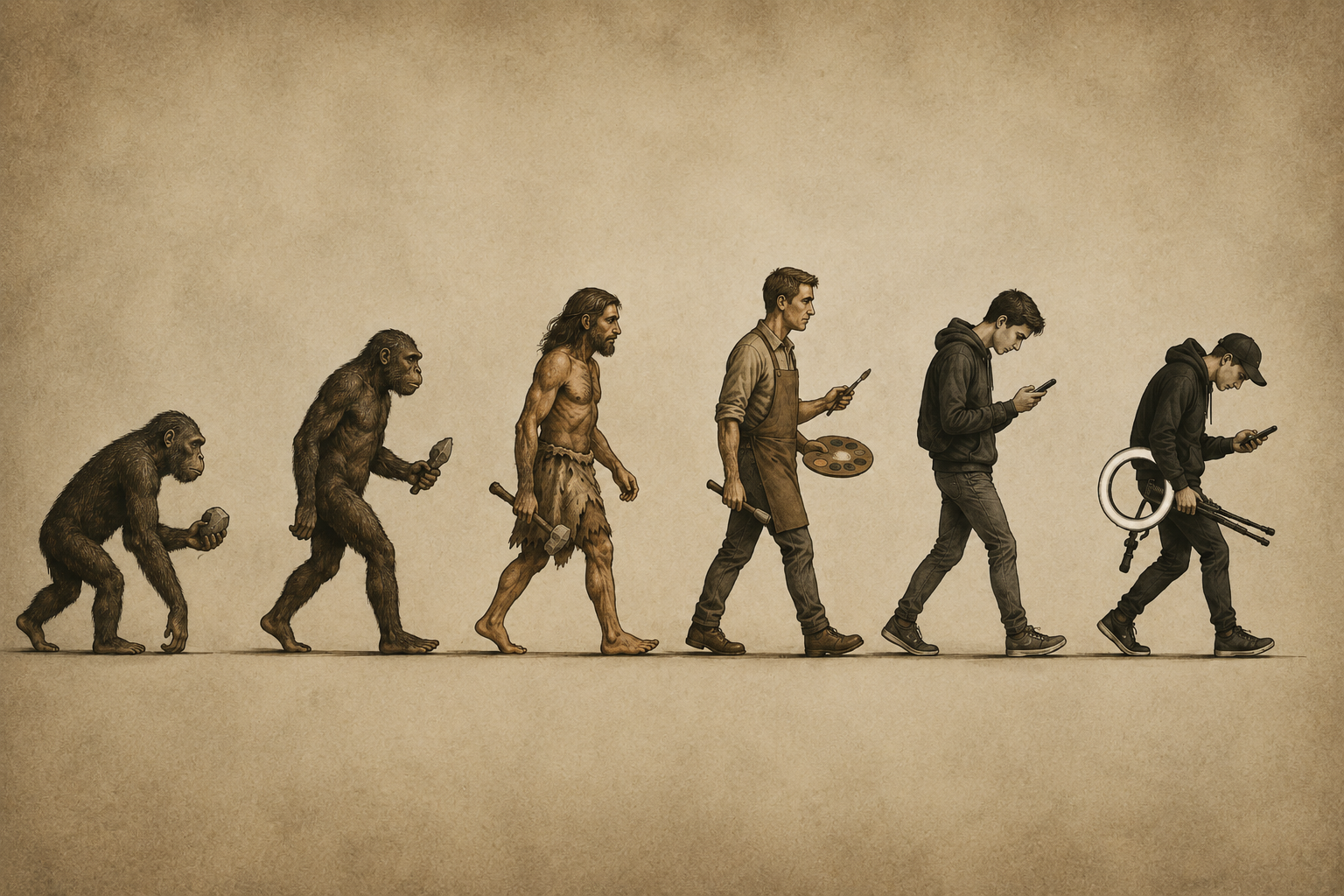
Once running rampant, now rarely seen outside captivity1, the tinkerer is a species teetering on the edge of decimation. Though they used to be found in abundance, their presence has been unknowingly2 diminished by that of elders claiming the species to be more invasive than functional. Their primary complaints included that of clangs coming from the garage at odd hours, coming indoors covered in unidentifiable muck, leaving traces of sketchbook smudged fingers on polished appliances, and notably, the incessant score of clacking keys in rooms lit by candles, the rattling of ice against glass while they fueled midnight whims.
Where they once left obvious markings—even intentionally for others to find—at present, one might only find evidence of such being in the margins of distracted notebooks or shoved beneath stacks of dust laden bins collecting musk in basement storage.
The only exceptions of this evidence derive from tinkerers long since past and remain hung in galleries or sold for millions of dollars, such as Jackson Pollock’s Number 7A, 1948, which sold for $181 million only days ago.
Rarely, this species can be spotted in the far reaching corners of the internet, moving too slowly for the average person to recognize them for what they are.
All of which begs the question of how a once bountiful, even celebrated species3, can be in such dire straits as to be named endangered. The research is ever ongoing, but one thing is clear: the decline was both fast and slow at once.
Slow in how long it took to reach devastating levels, and fast in the discovery of their endangerment having spread to every screen available in record time.
The cause of the decline has been a topic of debate from the beginning of its detection, with some postulating that it was in fact the species itself that led to the mechanism4 which shielded us from witnessing the decline, and therefore their own demise. To understand fully the evolutionary implications, we must first disillusion the growth of the tinkerer itself.
Put more plainly, everyone is born a tinkerer. Whether they make it to adulthood is dependent upon factors within and without their control.
Feral children are the first indications of a tinkerer on the rise. Adequate sunlight, a lack of adult supervision or involvement, and ample boredom maintained through adolescents and into adulthood are observed as fundamentals that nurture a healthy juvenile into a fully grown tinkerer.

But it was likely not a lack of these elements that drove the species to endangerment.
When a species begins to show signs of slowing is often a difficult moment to identify. Many believe it was the advent of the internet that so reduced their numbers. Others theorize it was the downfall of one Myspace that so began their dwindle. However, this reporter believes, with evidentiary support to come, the chief point of decline begins later, during a time in which the public remained in willful bliss, marveling at and capitalizing on the very structure behind such a devastating demise.
The year was 2013.
Photos of your dinner were prime social shares, six second videos from the since dismantled Vine became cultural phenoms, pencil-thin eyebrows blessedly lost their allure for a trend of full-form shape, and someone with a public social media account on Instagram amassed a following of millions thanks to her effortful sharing of growing muscle mass5.
Millions liked photos in which she showed off specific exercise growth and, after a time, exercises themselves that brought her the lauded displays.
She was not the first, and certainly not the last. She was, however, a pioneer in an explosive trend of self-employment. One which many tinkerers found themselves greatly successful in.
It was during this era that something destructive to the tinkering species began.
A single photo donning a particular brand influenced that person’s followers to buy the worn, used, discussed product, thereby catapulting that company’s sales.
Businesses took notice.
These individuals, later known under the umbrella term influencers, could now charge a large sum for a single photo, knowing it would garner thousands of likes and hundreds of comments, resulting in a sizable contribution to company sales. Additionally, a deal with the company could be struck, for the influencer to receive a percentage of direct sales.
The opportunity to earn a luxurious living from home, using nothing but one’s own work, was upon us.
Importantly, it is the first evidence in which a tinkerer was rewarded not for creating itself, but for sustained attention of the created.
However, while we remained distracted by the pull of an expanding and industrious interconnected world, with promises of fortunes depicted in lavish getaways6 and immaculate homes, the very species that thrived in such conditions had begun to suffer.
The tinkerer whose elaborately knitted cardigans with humorous slogans earned them recognition and related brand deals began questioning those same phrases against those that might prevent future sponsorship.
In an effort to produce more, faster, another’s once magnetic display of writing was replaced by structured templates devoid of the very essence that grew their public esteem.
Today, many tinkerers on the verge of demise can be seen deleting a TikTok or Reel after receiving only 40 views, half of which were their own in an effort to ensure a quality production. Others will now spend months building entire brand packages and assets prior to launch, only to later abandon them when they discover someone offering a similar product or service.
What’s more, it began affecting the young and yet developing.
Adolescent tinkerers were soon discovered unable to take action after learning a new skill, deeming themselves untalented and therefore wasting time when a first attempt did not match that of a fully grown adult.
In further evidence, over the last ten years, observations indicate an increase in research behaviors prior to beginning, with phrases like “will this earn money” and “how much can I make” and even “is this worth it” found in recorded search activity, despite the tinkerer’s initial desire to simply make. This behavior coincides with a significant increase in businesses offering aid in “optimization” and “monetization”.
By this time, thirteen years after this reporter’s suggested point of decline, accounts of unsuccessful endeavors, creating for the sake of learning, and other instinctive traits of tinkerers in the wild have nearly vanished, leaving behind a domesticated subspecies bound for collapse.
It is only in certain protected regions that adults have reportedly been seen beginning projects without first researching whether they were worthwhile. What’s more, there have even been some unsubstantiated reports claiming that tinkerers can still be found in the wild, engaging in activities they have little to no experience in7, using tools for purposes other than that which they were designed for, all with no expectations of monetization at all, leaving the public to wonder how this species will survive the expanding financial burdens of the present day.
When questioned about the nature of said actions, one tinkerer with wide eyes and a seemingly ever-present smirk crinkled a brow and said, “Yeah, and?” before letting out a whoop to its fellows and rejoining the pack.
We have yet to conclude whether giving their offspring unfettered access to cardboards, glues, dirt, and other potentially destructive materials is hazardous enough to warrant authorial involvement as it seems tinkerers, as a whole, are resolute in keeping the species alive in the offspring they shield from the growing harm they continue to face.
There are no clear plans, at present, for external intervention in the protection of this rapidly declining endangered species.
But there is evidence that despite a tinkerer having died on its path to adulthood, a revival can be made possible. This comes after someone reportedly discovered an old box of pipecleaners and beads, where on an impulse they could not describe, they wove a decorated piece into their hair, where it remained the entire work day.
Perhaps that, along with habitat preservation efforts, is the way this once prolific species can reign again.


